About Me

My photo
Delta, British Columbia, Canada
I took very early retirement from teaching in '06 and did some traveling in Europe and the UK before settling down to do some private tutoring. As a voracious reader, I have many books waiting in line for me to read. Tell me I shouldn't read something, and I will. I'm a happy, optimistic person and I love to travel and through that believe that life can be a continuous learning experience. I'm looking forward to traveling more some day. I enjoy walking, cycling, water aerobics & and sports like tennis, volleyball, and fastpitch/baseball. I'm just getting into photography as a hobby and I'm enjoying learning all the bits and bobs of my digital camera. My family is everything to me and I'm delighted to be the mother of two girls and the Gramma of a boy and a girl. I may be a Gramma, but I'm at heart just a girl who wants to have fun.

Monday, May 30, 2011

T is for Taormina and Tuscany

Taormina, a small town on the east coast of Sicily, was the ultimate of my Italian trip in 2006! Our guide saved it for last in order to give us all the most splendid of memories to take home with us. Situated on the Ionian Sea, it boasts warm beaches and spectacular views of Mount Etna, which kindly gave us a display of smoke and fire on our first evening. Also, the Teatro Greco is one of the most celebrated ruins in Sicily, still used today for opera, theater, and concerts. You may have heard of the author Truman Capote...He wrote of his stay in Taormina between April 1950 and September 1951 in his essay "Fontana Vecchia." Tuscany, a region in central Italy, is known for its beautiful landscapes, its rich artistic legacy, and its influence on high culture. I thought I'd died and gone to heaven when I arrived in the fall of 2006 and kept my camera at the ready for all the photo ops that popped up everywhere I turned. The people are welcoming, the food is scrumptious, the wine flows, and views are incredible. Cities and villages are equally exciting wih all their stories of times past, especially of the Etruscans, who created the first major civilisation in this region. Our group stopped at a vineyard for some photos ops and we were lucky to have our own picture taken by someone passing by. We visited a winery and sampled several varieties, to the point where we were all feeling a tad tipsy. This is one of my favourite shots of me wine tasting.

Without a doubt, the region of Tuscany and the town of Taormina were the highlights of my trip to Italy in 2006. I wouldn't hesitate to return some day, preferably renting a villa and car somewhere so that I could feel a real part of the country and the people. There is also a place where I'd like to take a week-long course in photography. And although I do not consider myself a cook by any means, it might be fun to take a cooking course for a day. Finally, I'd like to see more of the museums and art galleries and absorb as much of the culture as possible. Never been? It's a must if at all possible!

Wednesday, May 25, 2011

S is for SHIP to SKAGWAY

Hi everyone! Sorry not to have visited any of your great posts last week, but I was away on a lovely cruise to Alaska. As such, I'm going to show you the town of Skagway, famous for being part of the Klondike Gold Rush. Which of the following pictures do you think were the most important places in town?

You're right! All of them - for different reasons, of course!

When we arrived at 7:00 am, we were still asleep in our comfy cabin. However, D2 and I finally got up and ready for our day of adventure. We had decided to do an excursion on the "yellow streetcar," a 1927 Mack Model AB that was restored in April 2001 by Boyd Coddington. We were picked up promptly at 10:30 am right on the dock. The driver was a young lady dressed up in period costume and she was super in making us all comfortable and giving us a great tour of the town. The pier was a good 15-20 minute walk from town, so it was a relief for me that she picked us up at the pier. Because it had taken us over 3 hours to embark in Vancouver, I was in a lot of pain for most of the trip and it was hard for me to even walk for 3 days into the cruise. (Some of you will remember that I had serious back surgery 2 years ago.)

Our first stop was in an old building where we were entertained by a man giving us a dramatic rendition of the history of Skagway and welcomed us all into the "Arctic Brotherhood." We even got membership cards!

Then, our tour guide drove us slowly through the downtown area and part of the residential area, pointing out historical sites. Finally, we arrived at the historic cemetery where we were again entertained by a dramatic rendition of the story of Skagway's famous gunfight between "Soapy" Smith and Frank Reid. (Click here on Wikipedia and scroll down to "History" beside the photo to read about the gunfight. It's quite fascinating and amusing, too!) It was actually a bit sad to see the graves of babies and mothers who had died in childbirth and the graves of young men who had travelled so far to seek their fortunes by mining for gold.
Here's our tour guide telling us about the famous gunfight in front of Frank Reid's tombstone.

Our third stop was way up on the hillside where we had beautiful scenic vistas of Skagway. We could also see our ship docked at the pier in Lynn Canal, the most northern fjord on the Inside Passage of the Alaska Panhandle.

It was a great day, a bit chilly but no rain at least! D2 was dropped off back in town where she wandered happily on her own, while I opted to return to the ship for lunch and a good read by myself. A great day, part of a wonderful cruise and bonding time with my lovely daughter. More about the cruise as it fits into our ABC Wednesdays.

If you missed my R post, which I had automatically posted, be sure to check it out as it tells about Rome and Ravello. ABC Wedesday is the brainchild of Denise Nesbitt, who is now assisted by a sincere team of people from all over the world. Click here to check us out and please join in the fun!

Monday, May 16, 2011

R is for RAVELLO and ROME

I'm away this week, but decided to try and get this posted automatically...we shall see if it works! Although I'm in an "A" place, I'm going to tell you about two more places in Italy that are NOT to be passed up - Rome, of course, and the smaller, less well-known town of Ravello on the Amalfi Coast.

I landed in Rome in October, 2006, and was awed by the incongruity of ancient among the modern. Arriving at my hotel, right beside the Parthenon, I was welcomed to the incredibly modern Albergo Del Senato. The Parthenon dates back to 447 BC, yet inside my suite I slept on luxurious sheets and bathed and showered in great style! We wandered around the area, taking in the Trevi Fountain, the Spanish Steps, and the government buildings. We also spent a whole day at the Vatican, absorbing its history and incredible art. A little story about how I got the photo of Pope John Paul's crypt - we weren't allowed to stop in front of it unless you were behind ropes praying. As I walked past, I raised my camera and just snapped, hoping I'd get something, anything! Watch for it on the slide show. On our return from the Italian Riviera two weeks later, we viewed the Roman ruins and the Colosseum.

We then travelled south to Pompeii and to the Amalfi Coast, a spectacular bit of coastline. We stayed for 5 nights in Positano (see my P post) but drove around the area, visiting little towns and villages and admiring all the incredible views. We also spent a day on the island of Capri, but because the sea was quite wild that day, we were not able to get into the Blue Grotto. However, one of the prettiest places we saw was the town of Ravello where I wandered into a jewellry shop and came out several hundred euros lighter. I bought a sterling silver necklace that has a unique figure-eight design. (click photos to see larger) After checking out the church, I then wandered toward the Villa and its gardens. We were not allowed inside the villa, (there's a plaque on the side indicating that "Greta Garbo slept here") but we could spend as much time as we liked in the immense gardens that had views over the Mediterranean Sea.

So here's a little slideshow (all my photos!) I put together about my adventures in Rome and Ravello - hope you enjoy it. It starts with Ravello and then goes to Rome.


ABC Wednesday is the brainchild of Denise Nesbitt, now assisted by a team of ABCW'ers, including MOI! Join the fun by checking us out here.

Monday, May 09, 2011

Q is for QUESNEL - ABC Wednesday

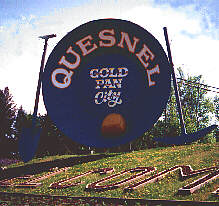
We're back in British Columbia this week for another destination - Quesnel (pronounced kweh-NEL). It's a very historic town in that it is named for Jules Maurice Quesnel who accompanied Simon Fraser on his journey to the Pacific Ocean. Quesnel is located along the Cariboo Wagon Road and was the commercial center for the Cariboo Gold Rush, which began in 1859. Also, because of its location on the Fraser River, it was an important landing for sternwheelers between 1862 and 1886 and again from 1909 to 1921. The town is pretty much in the middle of our ranch and cowboy country.

Currently, one of its most important festivals is during the third week of July when the town celebrates its heritage and the first gold miner, William Barker who struck it rich just east of Quesnel where we now have the historical town of Barkerville. Billy Barker hailed from Cambridgeshire, England, and struck gold in 1861 sparking rapid growth in the area because of so many men arriving to find their own fortune.

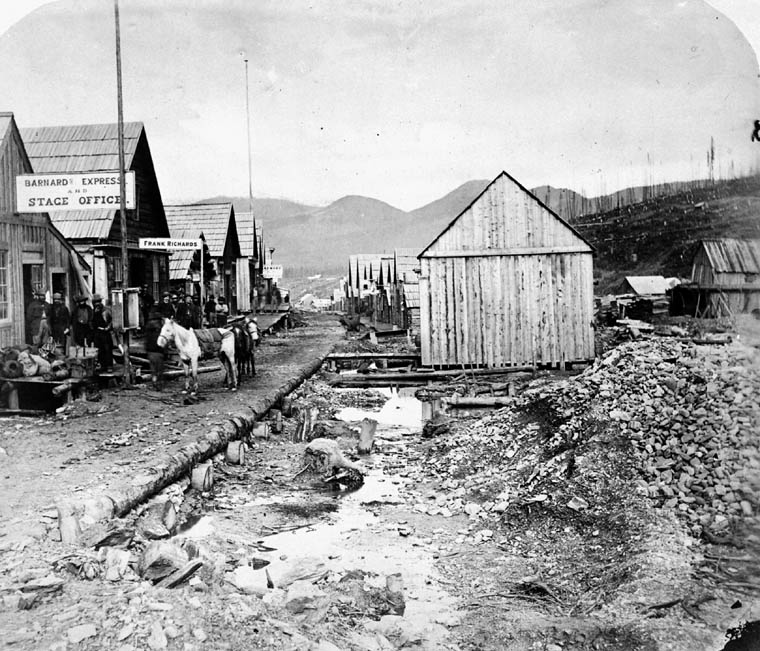
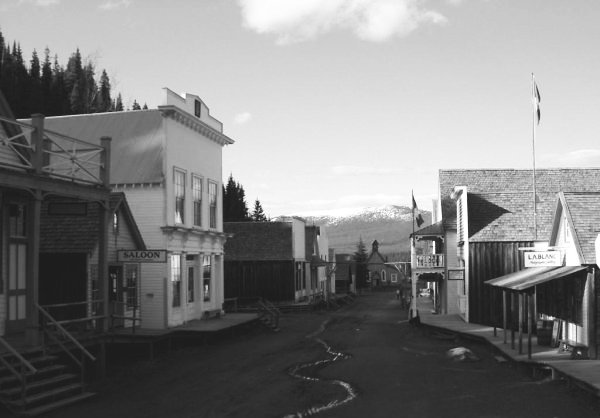
My one and only visit to Quesnel and Barkerville was when I was about 19 years old, home from my second year of university (my parents had moved 500 miles north of Vancouver to reside in Prince George, a few miles north of Quesnel). It was lots of fun exploring the old town with its saloon, schoolhouse, church, "Wake-up Jake's Restaurant," the theater, and the general store that was run by the Chinese, a very important part of the building of the town. I also panned for gold, but was unsuccessful. Below are a couple of old photos of me (in the pink top) and my sister and mother back in 1968 and below them are old file photos of Barkerville in 1865 and in 2004.

One more thing - all students in British Columbia learn the history of the Gold Rush and all about Billy Barker and his henchmen. Quesnel and its environs (i.e. Barkerville) are a major tourist attraction not only for BCers, but also for all Canadians and Americans alike.


ABC Wednesday is the brainchild of Mrs. Nesbitt and because it has become so popular around the world, she now has a group of quintessential aides! Check us out here!

Sunday, May 01, 2011

P is for Portofino, Portovenere, Positano


We're returning to Italy this week, not for the Pantheon shown here, but for three pretty places that I visited in 2006 - Portofino, Portovenere, and Positano.

First, I spent one day in Portofino, so named for the dolphins in the area. It's a small fishing village and resort on the northern rim of the Italian Riviera. The town is crowded around a small harbour and is considered to be one of the most beautiful Mediterranean ports. I climbed the hill by the harbour to visit Castello Brown, one of the town's main points of interest. From that vantage point, I managed to take many photos of Portofino and the yachts below. This castle was used to defend the harbour from as early as the 15th century. In 1867, the castle was purchased by the English consul in Genoa (Montague Yeats Brown) and he transformed the fort into a comfortable villa. Throughout the rooms, you can view photographs of many jet-setting celebrities who visited Portofino throughout the 50s and 60s - the likes of Elizabeth Taylor, Frank Sinatra, Ingrid Bergman, and Brigitte Bardot. A few of us had lunch on one of the patios in the harbour area and then did some window shopping, especially for Murano glass. Finally, Positano had the most beautiful cemetery I've ever seen. Gardens surrounded some of the plots and statues of saints and others decorated the area.

Next, is the town of Portovenere, one of the first towns along the Cinque Terre region of Italy. It dates back to the first century and is named after the goddess Venus. With its colourful facades, it made a dazzling first impression from the boat on which we arrived. We climbed the steep hill to the Gothic church of St. Peter, which was consecrated in 1198, and the Doria Castle. You can read about the castle's origins here. It was in Portovenere where I had my photo taken with a statue of a fisherman and began a tradition of having my photo taken with lots more statues in the weeks ahead throughout Italy.

Finally, we checked out Positano on the Amalfi Coast, south of Rome. We stayed here for 5 nights and not only explored the coast and some of its little towns (Amalfi, Atrani, Ravello), but also took a day trip to the Isle of Capri. Positano sits in the hills leading down to the coast and a beautiful, protected beach. It was a relatively poor fishing village in the first half of the 20th century because more than half its population had emigrated, mostly to Australia. However, after John Steinbeck published an essay about Positano in Harper's Bazaar, it started to attract many tourists. Steinbeck wrote, "Positano bites deep. It is a dream place that isn't quite real when you are there and becomes beckoningly real after you've gone." I certainly can relate to that! The town was also featured in the movie, Under The Tuscan Sun (2003) and Nine (2009) and was the setting for the romantic adventure novel, Finding Positano, A Love Story (2010). The little port of Mongibello was also based on Portofino in the movie The Talented Mr. Ripley and parts of the movie were filmed here. It was in Portofino that I bought a pair of Italian leather loafers and tasted excellent gelatto!

I cannot say enough how much I love Italy - its people, culture, food, wine, and history! If you ever have an opportunity to visit, here's a tip - avoid the "touristy" places like Pisa and go to one of these three places - Portofino, Portovenere, or Positano. You will not be disappointed! Hope you enjoy the slide show - all my photos except for 3 scanned postcards.


Monday, April 25, 2011

O is for Orvieto

Come with me this week to Orvieto, one of my favourite places to see in Italy. Located just outside of the border of Tuscany, it is found in Umbria at the top of a huge chunk of volcanic rock (tufo) just off the freeway between Florence and Rome. We drove up narrow roads and through narrow alleyways to our hotel, which was in the center of the old town. A short walk took us to the Duomo and the Archaeological Museum. Both were fascinating to see!
We also toured the caves beneath the town. Orvieto is honeycombed with Etruscan and medieval caves where you can see an old olive press, two impressive 130-foot-deep well shafts, and the remains of a primitive cement quarry. This underground city boasts tunnels, galleries, wells, stairs, quarries, cellars, unexpected passageways, cisterns, superimposed rooms with numerous small niches, detailing its creation over the centuries. (from Wikipedia) You can only see this area with guides and it's definitely worth it to go check it out. In 2008, I wrote about the caves here.
The other truly fascinating place to visit here is the Necropolis. We wound our way down the mighty cliff to meet our guide at the end of our descent. Here we found an ancient burial site formed like a "town." The necropolis...is made up of a series of small chamber tombs, aligned along the burial "roads". The arrangement of the tombs, which follows a definite "town" plan, provides precious elements for the study of the layout for the ancient city. Built from blocks of tuff, the entrance lintels of the tombs are inscribed with the name of the deceased. The earliest excavations in the 19th century yielded important artifacts...(from here)
One free afternoon, I wandered the narrow streets of Orvieto, taking photos of things that caught my eye. There was a wooden wall sculpture depicting the story of Pinocchio, a Trojan horse, a cow, a mythological creature, hanging baskets, and windows holding potted plants. If the slide show doesn't work properly like last week, simply click on the picture and you'll be taken to a new screen. Then click "full screen" and you'll be able to see the pictures for sure. Enjoy!


Without a doubt, this was one of the highlights of my month-long stay in Italy! I highly recommend visiting Orvieto and staying a minimum of 2 or 3 days in order to experience everything it has to offer.
ABC Wednesday is brought to you by the outstanding Mrs. Nesbitt and her team of organizers. We're in our fourth year now and would love for others to join in and contribute their poetry, prose, photographs or artwork - actually anything you'd like to share! Check us out here!

Sunday, April 17, 2011

N is for NEIGHBOURHOOD

This week, I'd like to bring you to a destination close to home - my neighbourhood, (the area in which we raised our two daughters) and to a beautiful oasis of nature in the midst of a residential area. I'm taking you to Diefenbaker Park, named after the 13th Prime Minister of Canada, John Diefenbaker. Our home was a short walk (or bike ride) from home and every day, I'd take our dog for a walk around the area. In the warm months, the girls would take the dog running alongside their bikes, baskets full of sandwiches, drinks and a jug of water and bag of biscuits for the dog, and head down to their special place at the park. You will see "the rock" where they'd sit and talk and eat and do whatever daydreaming their young hearts and minds could conjure up. They wouldn't come home until it was time for dinner. I always trusted they'd be home on time and they'd take great care of their beloved Star. In those days, the park had the pond but the bridge was added many years later. At the top of the hill is the start of a waterfall and a smaller area from which you can look east to Boundary Bay and north to the Coast Mountain Range. D1 had planned to get married here but it rained, so we had to go to Plan B. In some of the pictures, you can actually see how close the houses are to the edge of this park. On winter days if it snows, everyone races to this park with sleds or even garbage can lids to slide down the slopes. On good days, you will always see families with children playing on the swings and slides while Mom and Dad prepare lunch or dinner on the barbecues that are provided. Paths meander through and past beautiful gardens full of seasonal plants and flowers. The pond has sprouted many many reeds over the years and half the pond is idyllic while the other half seems quite wild. Trees drape their branches thick with greenery over the water as the many varieties of water fowl slide along. Here you will see not only different kinds of ducks but also loons and herons. There are also turtles of varying sizes basking on the rocks. Summer evenings now have weekly outdoor music concerts and movie nights. Towards the end of the slideshow, you'll see Fred Gingell Park, a very small wooded park along the western bluff of the area that overlooks the ferry terminal that takes you to Victoria and the rest of Vancouver Island. It also has fantastic views of the Gulf Islands to the west. There are hundreds of winding steps and paths descending 150 meters (1500 feet) down the cliff to the beach below. Athough many people go there every day for a workout, I have yet to attempt it. I'm afraid I'd get down and not be able to get back up. Here are 2 photos of D2 taken by D1 down at the neighbourhood park. Both girls took photography in high school, and this was one of D1's assignments. At this time, she was about 16 and D2 was about 12. I had the photos framed and they're now in the possession of D2. She kindly allowed me to share them today. I'm very proud of both my daughters - both are great photographers and great models. Naturally, they had a beautiful neighbourhood in which to practise their craft.
I have no idea why the slideshow sometimes acts up, but if it does, just click on it and a new screen will pop up so you can see it properly. Sorry!

Thanks to Denise Nesbitt for starting ABC Wednesday - gosh, we're into our 4th year now! It's grown so popular that Denise now has a group helping her out. Check it out here and join in any time! It's a great way to meet people from all over the world.

Thursday, April 14, 2011

Proof of Jesus' Crucifixion?

From an article in the newspaper, it appears that two nails have been discovered in a 2,000-year-old tomb just outside of Jerusalem. "Simcha Jacobovici, who has made a documentary about the find for the History Channel, contends the nails were used to hammer Christ to the cross. He believes the high priest may have wanted them buried alongside his body as divine protection in the afterlife."

Now even though I have a very strong faith, I immediately thought that this was a hoax. However, after reading further, it appears that the boxes in which these nails were found belonged to the Jewish high priest (Caiaphas) who has historically been known to have only been associated with Jesus' crucifixion.

This discovery is believed to be the best archaeological argument ever made that two of the nails from the crucifixion of Jesus have been found.

Your thoughts?

Monday, April 11, 2011

M is for MONREALE


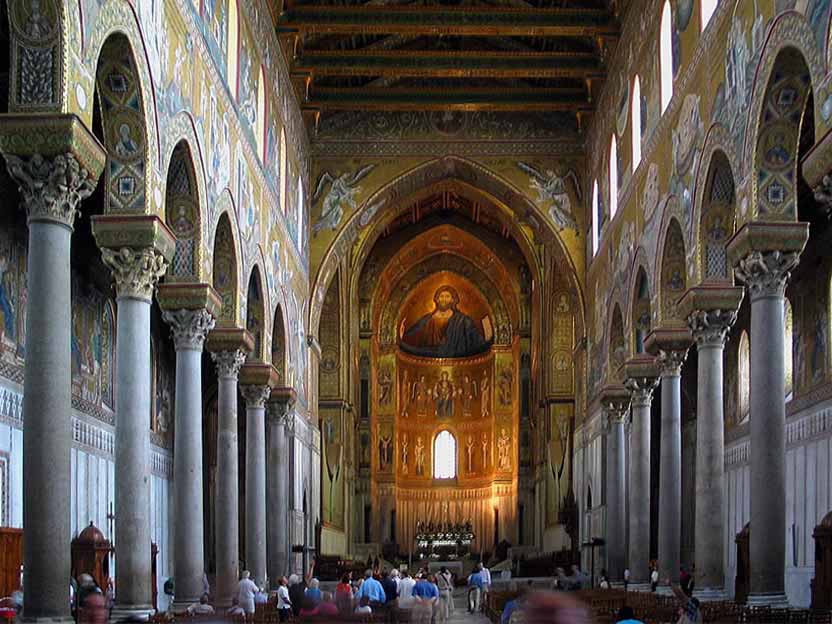
"Monreale is the swan-song of the art of the Norman Age." So begins my book about the Cathedral of Monreale near Palermo, Sicily. It was one of the last places I visited in 2006 during my month-long stay in this most marvelous country. Monreale was the brainchild of William II (1153 - 1189), the last of the great Norman Kings of Sicily. Apparently, one day while hunting in his park, the King fell asleep and was visited in his dreams by a lady (the Madonna). She indicated to him the place where his father's treasure was hidden and later, the King did unearth it. In gratitude, he decided to erect a temple dedicated to the Virgin Mary on Monte Reale. However, King William died before seeing the cathedral completed. In 1267, a century after the commencement of work, the church was solemnly consecrated by an envoy of Pope Clement IV. The interior of the cathedral is a masterpiece of late Romanesque architecture and consists of three aisles terminating in a transept and three apses. An immense mosaic tapestry covers the greater part of the walls. There are 18 antique granite columns and one in cipolin marble. The marble tombs of William I and William II are situated in the right wing of the transept.
While visiting Monreale, I sat transfixed in the main chapel. Everywhere you look - up, down, left, right, straight ahead and behind - you will see the most magnificent architecture and artwork! Mosaics, sculptures, bronze leafs, tapestries, arches with decorative motifs. We stayed more than half day, wandering both inside and outside along the cloisters. There are several portals and smaller cathedrals inside the main structure and we were awed by the majesty of the art. The artwork describes the story of the Christian Bible from creation to the miracles of Jesus Christ. There is literally far too much to describe in this little post, but trust me in saying that it is definitely a major must-see if you are ever in Sicily! Below is a confessional, a statue of King William offering the cathedral to the Virgin Mary, and a photo of the main chapel.


Sunday, April 03, 2011

L is for London, Looe, and Leeds Castle

In keeping with my theme of "destinations," I was checking my photo albums for place names beginning with the letter L. There were so many that I decided to narrow it down to telling you about when I took D1 on a tour of England, Scotland, and Wales. This post will focus on a few places in England that we visited and really enjoyed. I'll save Scotland and Wales for another time. I also rummaged around for the journal I keep when I'm travelling and found the notes I made on that trip in August, 1998. I will ask you to forgive the quality of the photos as there weren't digital cameras then - these are all scanned from the photos I took with my old Ricoh. First comes LONDON, of course! We had a wonderful few days there touring around on the "hop on/hop off" bus. From my journal: A day in London showing Jamie the sights - we walked up to the Victoria & Albert Museum and got on the London Pride. We went up to see Madame Tussaud's, but there was a double line all the way around the block! So back on the bus and to Rock Circus in Picadilly. That was pretty good - then the Fashion Cafe for lunch...We got off the bus at Trafalgar Square and walked the Mall to the palace and then saw the Horse Guards on inspection... Here's Jamie posing in front of Big Ben. Next stop is LOOE, a small coastal town and fishing port about 20 miles (32 km) from Plymouth. "...very pretty with lots of seagulls and boats." Apparently, the village has a history of smuggling when Barbary pirates (Muslims from north Africa) swept in and captured 80 people from Looe and took them into slavery! Here's Jamie on the pier at Looe. The third spot, one of my favourites of the entire trip, was a visit to LEEDS Castle in Kent, southeast of London. We stayed a long time here, exploring the Aviary, the castle island, and the Maze (in which we got lost!) I would definitely go back to Leeds Castle on my own and take a picnic lunch to eat on the vast lawns. Here are some photos of us. I eventually gave up on the Maze, allowing the guide to help me through, but Jamie persevered and finally joined me on the Mound where the guide kindly took our photo. We weren't finished yet, though, because in order to get out, we had to find our way through the Grotto, which was rather dark, wet, and eerie. But we managed and had a good laugh afterwards. The last place I want to highlight is Coventry. I know it doesn't begin with the letter L, but it was the home of the famous, or should I say "notorious" LADY Godiva! "We saw the old and new cathedrals in Coventry and the statue of Lady Godiva..." According to legend, Godiva's husband would only reduce taxes on his tenants if she would strip naked and ride through the town covered only by her long hair. She took him up on it, issuing a proclamation that all villagers were to stay indoors with windows shut. One man (afterwards known as Peeping Tom) disobeyed the proclamation, boring a hole through his shutters and peeped at her. He was immediately struck blind! My best memory of the city of Coventry, though, is more about the old cathedral that was bombed on November 14, 1940, during WW2, leaving only a shell and the spire. The new cathedral, St. Michael's, was built immediately beside the original site and I took a photo of Jamie standing in front of the wall with the impressive sculpture of "St. Michael's Victory over Satan." I want to show you a close-up photo of the statue as well as the one I took of Jamie standing beneath it - it shows the Largeness of the statue...


I hope you enjoyed this little bit of London, Looe, Leeds Castle, and the story of Lady Godiva from Coventry. When we get to the letters S and W, I'll tell you all about Loch Ness and Llangollen. Until then, remember to check out the other contributions to ABC Wednesday, the brainchild of Mrs. Nesbitt at this link.