About Me

My photo
Delta, British Columbia, Canada
I took very early retirement from teaching in '06 and did some traveling in Europe and the UK before settling down to do some private tutoring. As a voracious reader, I have many books waiting in line for me to read. Tell me I shouldn't read something, and I will. I'm a happy, optimistic person and I love to travel and through that believe that life can be a continuous learning experience. I'm looking forward to traveling more some day. I enjoy walking, cycling, water aerobics & and sports like tennis, volleyball, and fastpitch/baseball. I'm just getting into photography as a hobby and I'm enjoying learning all the bits and bobs of my digital camera. My family is everything to me and I'm delighted to be the mother of two girls and the Gramma of a boy and a girl. I may be a Gramma, but I'm at heart just a girl who wants to have fun.

Monday, October 31, 2016

Q is for QUAINT


Welcome to ABC Wednesday where this week we honour the letter Q as in queen, quit, quiet, quintessence, queer, and quench.  This time, I'm basing my post on the word QUAINT and would like to share with you a few photos from my summer travels in England and Wales that I felt were rather quaint...like shops, gardens and garden pots, artwork, restaurants, and more.  The word "quaint" defines things that have an old-fashioned charm, are oddly picturesque like a quaint old house, are peculiar or unusual in an interesting or amusing way, or are skillfully or cleverly made.  Dear friends John and Marion took me to see Jane Austen's museum where I saw her bed, writing desk, and artwork while other dear friend Liz took me to the most quaint town of Tenby in Wales. Wait until our T week!  And because my dear friend Jill has lived near Whitby, North Yorkshire all her life, she knows all the shortcuts to out-of-the-way spots that most tourists would never see.  Thus, I got to wind my way through narrow alleys to see the most beautiful and quaint back gardens and quaint little shops that only the locals know about.  So click on the photo below, turn up your music, click the arrows for full screen, and enjoy!

Click to play this Smilebox slideshow


Monday, October 24, 2016

P is for POET (Dylan Thomas)

This week at ABC Wednesday, we honour the letter P as in place, person, pastry, pancakes, pigeon, peculiar, popcorn, painful, passionate, and pepper. 

Going back to my trip to Wales this past summer, I'd like to tell you a bit about Dylan Thomas, who is considered to be "Britain's last romantic poet.  Now poetry has never been my particular "thing," but after visiting his house in the small village of Laugharne, (pronounced |Larn) I recalled that I had read many of his poems throughout my life.  To begin with, here's a bit about him from Wikipedia:

"Dylan Marlais Thomas was a Welsh poet and writer whose works include the poems "Do not go gentle into that good night" and "And death shall have no dominion"; the 'play for voices' Under Milk Wood; and stories and radio broadcasts such as A Child's Christmas in Wales and Portrait of the Artist as a Young Dog. He became widely popular in his lifetime and remained so after his premature death at the age of 39 in New York City. By then, he had acquired a reputation, which he had encouraged, as a "roistering, drunken and doomed poet".

Arriving in Laugharne, Liz and I parked along the estuary of the River Taf - below the homes straight ahead in the photo from Mr. Google.  You can see Dylan Thomas' boathouse on the right just above the water line.
We headed past the ruins of Laugharne Castle (built in 1116) hanging above us on the cliff and climbed the path that would bring us to not only Dylan Thomas' house, but also to the shed where he did most of his writing. 
First, we found the shed and peered inside.
It was locked to preserve the interior and its contents, but by putting my camera right up to the window, I was able to get this shot. Thomas' jacket hangs over his chair in front of a window out of which he would gather inspiration from the spectacular views across the estuary.  There was a small pot belly stove and wood beside it so he could keep warm in the cold winter months and a bookshelf that appeared to be as he would have left it.  Do you see the crumpled up pieces of paper under the desk?  A true writer of the times - no "delete" key then!
Outside the shed, on a sign posted in his memory is one of his famous poems, fitting the season in which we are now, "Poem in October."  The photo isn't great, but it was the best I could get at the time.  And I feel honoured that I share an October birthday with this famous poet.
Liz and I then continued further along the path admiring the views until we found the steps down to Dylan Thomas' house.  The first thing I noticed was a pair on long johns hanging from a tree and blowing gently in the breeze.  I laughed, but then realized that they would have been Thomas' and where he would have hung them to dry - as there was no washing machine or dryer in the house.  This bit of history was the introduction to his house where things had been left (or placed) as they would have been while he was in residence.  Tourists are not allowed to take photographs inside the house, but I did get several good ones of the views Thomas would have had.  If you're interested in seeing the interior of the house, just look up Dylan Thomas Boathouse online.
I was thrilled that Liz asked me if I'd like to stop by to see this area, as we'd already spent half the day in Tenby.  Considering my bad back, I feel great that I was able to manage all that in one day...there was a lot of walking, but it was slow and meandering, and we took many small breaks.  So, thank you Liz so very much!  This post is dedicated to you in remembrance of a perfect visit!

Saturday, October 15, 2016

O is for OXWICH (a village in Wales)

Welcome to ABC Wednesday where this week we celebrate the letter O as in oven, ornery, oblivious, olive, obstreperous, ocean, and Olympian.  I would like to take you to a pretty little church in Wales that I visited this past summer with my friend Liz.  It's called Oxwich and is located at the Western end of Oxwich Bay on the Gower Peninsula near the village of Oxwich and the city of Swansea. 
With a population of less than 200, Oxwich boasts two castles, lots of thatched cottages, and a National Nature Reserve.  Also, there is the extensive beach on the Bay with sand dunes, towering cliffs, and shady woods.   We bypassed Oxwich village itself, but the beautiful approach road travels down through the woods and out into the salt marshes and the Reserve. After parking near the beach, Liz and I enjoyed a very casual lunch at the little cafĂ© by the water before heading along the pathway through the woods to the ancient church.  Here is a photo I took as I approached the front:
The church derives from a 6th century monastic cell. The present church was largely built during the 13th century incorporating the cell in the base of a massive embattled tower with a saddleback roof. For the millennium celebrations the tower  was re-opened into the church and the area restored as a  simple but beautiful chapel. 

Other notable features include the burial niche in the north sanctuary wall, would have marked the grave of someone of note; possibly even Illtyd himself. Also the bells: two are rung, dating from 1716 and the third, dating from the 15th century, now lies inside opposite the entrance. The massive yew tree  in the churchyard is believed to be as old as the church itself.


To the left as you look at the tower (above) and in behind I spied this old water barrel.
The church's cemetery surrounds the outer perimeter of the church building and goes up the hill in behind.  Liz and I wandered around the tall grassy area looking at inscriptions on lots of the stones. They go back centuries!!! And there are even some fairly recent ones there, too, as the church still has services to this day.  I don't want to sound "sappy," but I did feel a presence and a peace while on the church grounds with Liz that afternoon.  Hope you enjoy the very brief (12 shots) video presentation with its haunting accompanying music.
Click to play this Smilebox slideshow

Tuesday, October 11, 2016

Nasty, Naughty, Nice

Welcome to ABC Wednesday where this week we celebrate the letter N as in navy, nice, notable, never, nephew, neutral, noise, and night.  I'm a bit late doing this post because we've just had our Canadian Thanksgiving, which was a long weekend.  I am greatly thankful for the team that works so hard to keep ABC Wednesday going - the neighbourly Mrs. Nesbitt, creator of this meme, the noble Roger, our administrator, and the group who navigates weekly to all the contributors to leave numerous notes extolling their photographs, poetry, or prose.

Anyway, I had a nasty fall yesterday along the trail where I take Tegan for her walks.  The sun caught my eyes and I stumbled over some roots that reached out to grab me!  Down I went, my shins landing right smack on those noxious roots!  I told myself, "You're okay! You're okay!" as I managed to get to my feet.  But later, I felt nauseated from the pain and swelling that quickly developed.  After icing my legs for an hour when I got home, I decided I better head over to the ER for x-rays.  Thankfully, they're not broken; however, they are very badly bruised.  I need tensor bandages to keep the swelling down, extra strength acetaminophen, and continuous icing.  This morning my right leg seems a bit better even though my knee aches something terrible.  But my left leg keeps sending wretched, spasmodic signals of pain every time I move it any little bit. 

"This too shall pass" as my mother used to say.  So taking a break from recounting stories and photos of my recent travels, I shall share with you one of Tegan's newest "boy friends" whose name is Angus.  They see each other in the back garden and love playing together, but Tegan is sometimes naughty with him even though she means to be nice.  They both love to play with balls and having someone toss it so they can chase after it.  Tegan usually gets it, but if she doesn't, she pesters Angus until he drops it for her. 
"Can I play, too, Tegan?"
"Try and get it, Angus!"
 "Not so close, big boy!" 
"Aw, c'mon, it's my turn!"
"Mommy!  She won't share!"
And one final shot of Tegan and her nose asking me if she has spinach in her teeth! 

Sunday, October 02, 2016

M is for MOORS

As I've been so busy lately, please excuse this repeat from October, 2016.  But I think the new contributors will enjoy it and the old ones might, too.

This week on ABC Wednesday, we're celebrating the letter M as in moss, mother, mist, mushroom, macadamia, melancholy, Manitoba, marching, mud, and magnanimous!  I am focusing on the moors of North Yorkshire where I spent a week visiting my dear friend Jill and her family and friends! It was the most marvelous week and I miss them all very much - the people and the moors and look forward to making another visit some day.

For those who are not aware, the North York moors contain one of the largest heather moorlands in Great Britain covering an area of 554 square miles or 1,430 square kilometers.  When the heather is in bloom, it a magnificent sight to behold!  But even when it's not blooming, if you go up to the highest point on the moors, Chimney Banks, there are vast expanses of gently sloping hills and valleys with farms scattered throughout and sheep grazing on the hillsides.  The coastline here along the eastern edge of Great Britain boasts of small towns and villages, some perched precariously on the edge of cliffs or hillsides.  Whitby, Scarborough, and Robin Hood's Bay are all places I visited during my trip and made me want to never leave!

If you're a fan of the TV show "Heartbeat," on Knowledge Network in British Columbia and maybe on public networks elsewhere in the world, you will see the locations where the show was filmed. So now when every Saturday night at 8 pm, I settle down to continue watching the show, I can make note of places I've seen with my own two eyes - Beggar's Bridge, the high road along the top of the moors, the cemetery at Egton where they filmed all the funeral scenes, the village of Goathland where the fictional "Aidensfield" is set and its train station where parts of the Harry Potter movies were filmed, Scripps Garage and the "Aidensfield Pub" where Jill and I had a glass of wine one evening.
I truly believe I could happily move into a small cottage in a small village in this area and spend much time photographing the people and the scenery in all seasons.  And I can picture myself finding spots along the beaches, hills, or valleys where I would take a notebook to do some creative writing.  I know that I am fortunate to live in a country like Canada, on its west coast near the ocean with its spectacular scenery, but there is something about the moors of North Yorkshire that continue to call me during my waking hours and whisper to me as I gently slip into dreamland. 

I hope you enjoy my photos of these moors but I am sorry I don't have any from when the heather is in bloom. So here's one from Mr. Google so you can marvel along with me. I recognize this spot as it's quite near the village of Grosmont where I stayed with Jill. 

I dedicate this post to Jill for her friendship and hospitality and especially for the wine!
Turn up your sound and click for full screen to fully enjoy the video with its haunting music.  With thanks to the merry Melody, our new administrator of ABCW, and to the matchless team of assistants.

Click to play this Smilebox slideshow

Sunday, September 25, 2016

L is for LLANBERIS

This week we are honouring the letter L as in lion, letter, language, leapfrog, lettuce, llama, lovely, and literature.

While visiting Wales this summer, I learned that lots of places haves names beginning with a double LL...like Llandundno, Llanarth, Llandona, Llandyfrydog, Llanellen, Llangeview, and Llechcynfarwy. Now the "Ll" part at the beginning of the name sounds kind of like a hard "chl..." and Llan means "village" or "parish" and Llech means relating to slate. One of the loveliest places I visited was the village of "Llanberis" which is where you get the train to go up Mount Snowden.  It was a lighthearted day with my friend Jane and the village was lively with tourists, both Welsh people and people from other parts of Great Britain and the world. 

We started off on our own tour of the area, first stopping at a local lake called Padarn Lake, where we saw boats lazily drifting along.  There is an entire country park at this lake (or Llyn, in Welsh) where you can see Dolbadarn Castle, Quarry Hospital - a museum housing the restored ward, operating theatre and various gruesome 19th Century hospital equipment, the National Slate Museum, a diving center, and more.  We stayed on the side of the lake where we got the train up the mountain, and while awaiting our turn, we had an hour to kill.  So we wandered over to the Llanberis Lake Railway where a little steam engine takes you on a five-mile return journey around the lake. Watch the youtube video below and be sure to turn up your sound for the music and some explanations and you can also watch it in full-screen, just clicking on "escape" to go back to normal. I'm going to do this trip next time I'm in Wales.


Then it was time to load the train with the 3 o'clock visitors so off we went.  It wasn't sunny, but it wasn't raining so we locked hands and hoped the weather would hold until we reached the summit, which was an hour's ride away.  We had to laugh as we got about halfway when the rain started coming down in sheets!  Well, we wouldn't get the lovely view from the top, but we did have a coffee and bought some postcards of the view when we got there.  It was a bit better going down, and the sun was shining when we reached the bottom.  It was well worth the ride, though, and I would do it again in a minute.  Enjoy the brief slideshow of our time there. All the photos are mine except two at the end that I found online but don't know the photographer. 

Click to play this Smilebox slideshow
With legendary thanks to the Lady Denise Nesbitt, creator of ABC Wednesday, and to
Lord Roger, our administrator, for all the laborious work he puts into organizing our weeks. Also, thanks to the loyal and lively group of assistants who leap through their day so they can leave all of us lavish and limitless appreciation of our contributions.

Sunday, September 18, 2016

K is for KITES


This week I'm interrupting the flow of my "travelogue" to bring you a bit of local fun - flying kites! I was busy doing something really exciting one day (laundry, dusting, etc.) when my daughter called and said to grab my camera and head down to Patterson Park.  There was a keen bunch of people flying kites!  So, feeling a bit peeved that I had to knock off my fun activities, I did as she suggested.  I was quite bowled over at the size of these kites and all the kaleidoscope of colours. I took quite a few shots and here's the end result. (It's very short)

With thanks to the group at ABC Wednesday - Denise Nesbitt, our creator, and Roger, our administrator. 
Click to play this Smilebox slideshow


Sunday, September 11, 2016

J is for JET

Jet is a semi-precious stone and when it's polished, it takes on an extraordinary lustre of deep black.  This rich black colour never fades, and the shine is so intense that polished jet was even used as mirrors in medieval times. It comes from a pure and hard form of fossilised wood and is found in thin seams of shale rock. 
Whitby, in North Yorkshire (England), is famous for its jet. In the 19th century it was found and mined throughout the North York Moors and brought into Whitby by pack pony to be made into a wide range of decorative items ranging from jewellery, busts, dolls house furniture, models of Whitby Abbey, chess tables to many other small objects.

However, when the railroad lines eventually made their way to Whitby, the Victorians started to arrive because it made a jolly seaside holiday destination.  And a piece of jet was de rigeur as a souvenir!  Queen Victoria even began wearing jet jewellery in remembrance of her husband Prince Albert.
My joyful and dear friend Jill, my hostess this past summer in North Yorkshire, took us both on a jaunt to the old part of Whitby where we jostled the crowds and looked at lots of jet jewelry.  I wanted to bring my daughter a small piece (it's not cheap, believe me!) to thank her for looking after Tegan while I was away.  We went into many jewelry shops and peered at all the jazzy displays.  You can see the ones I chose on the slideshow.

If you're interested in a presentation of how jet is produced and some samples of current day jet jewelry, please feel free to check out the slideshow I've put together.  In order to have time to read the brief signs explaining each piece of equipment, etc., just pause the slideshow and then click to continue.  It is quite fascinating to see all this old equipment they used back in the day!

With jovial thanks to the creator of ABC Wednesday (Denise Nesbitt) and to our jocular administrator, Roger.

Click to play this Smilebox slideshow

Monday, September 05, 2016

I is for ITALIAN GARDENS

Welcome to ABC Wednesday where this week we celebrate the letter I as in ice-cream, igloo, innovative, idol, injure, image, and irony.  I'd like to introduce you all to a place I visited while in south-east Wales this summer - the Italian Gardens at St. Fagen's National History Museum.  I had visited this immensely innovative outdoor museum back in 2006, but the month of November was not a fitting time to see any of the gardens.  I must say that I lucked out with the sky being grey but no rain fell.  Suffice to say that my goal this trip was to view the gardens on a brilliant sunny day!

From a historical standpoint, the gardens were created some time after 1864.  It is a walled area that was adapted in 1902 by Lady Paget so her children could go swimming in the pool.  The walls at this pool are now fitted with water jets that arc into the pool.  There are grassy steps, ornamental tubs that contain orange trees, and roses that are trained to grow upwards on the walls.  Lady Paget also had a room beside the area where she could do painting and enameling.

HRH the Prince of Wales, had the honour of opening the restored area as an Italian Garden on July 27, 2003.  I'm so glad my friend Jane and I decided to follow the path towards this spot.  We were getting tired from all the walking and had considered heading back to the car.  I'm so glad we didn't. Anyway, here are a few of my own photos of the gardens.  By clicking on the photos, you can see them in full screen format.


With immortal thanks to the imaginative Mrs. Denise Nesbitt, creator of ABCW, and to the imperturbable Roger, our administrator.  It's also imperative to give thanks to the impassioned
assistants who visit each and every contributor to leave invaluable words of praise.

Sunday, August 28, 2016

H is for Homes, Hostels, Hotels

Welcome to ABC Wednesday where this week we celebrate the letter H as in hot, healthy, hamburgers, hat, humdinger, hair, hill, and hawk.  I'm continuing the travelogue of my trip by bringing you an area of north Wales that was absolutely heavenly!  My paternal grandmother was born in Llandudno, Wales, on April13, 1896, at 28 Jubilee Street.  She was greeted with joy after her mother had given birth to 5 boys and after that, she went on to have one final boy!  My dream has always been to see where she was born and brought up, only coming to Canada after the second world war with her husband and young son.  My father and his 2 sisters were born in Canada.

My epic dream of seeing Llandudno finally arrived this summer (2016) and I was absolutely amazed at the beauty of the area. An historic town, Victorian and Edwardian atmosphere prevails everywhere, especially with the houses, hostels, and hotels.  Even the newer built homes have a Victorian feel to them!  The countryside is beyond beautiful, and the entire area faces out to the Irish Sea.  And the people are so humble and  hospitable.  Take away the modern cars and you feel as though you have gone back in time.

I would like to share some of the beauty of the area through a short slideshow presentation.  Mr. Google helped me out here, but I've indicated which photos are mine.  And, if you're interested in learning more about this place, please check out http://www.llandudno.com/  Remember, don't tell too many people about this piece of heaven on earth - I want to go back some day and spend more time there.  And I don't want any crowds!  LOL

With humble thanks to the hysterical Mrs. Nesbitt (you'd know just how hysterical if you follow her on Facebook and saw her scarecrows!) and to the always hardworking Roger, our administrator. Also, don't forget to give a silent nod of thanks to the helpful team of assistants who visit all the contributors to leave heartfelt comments. 

Now...on with the show and don't forget to turn up the sound and click on full screen!  Oh the music is called "Epic Journey" and you won't hesitate to realize why I chose it.  *smile*
Click to play this Smilebox slideshow

Sunday, August 21, 2016

G is for GROSMONT and GOATHLAND


Welcome to ABC Wednesday where this week we celebrate the letter G as in goat, gorgeous, giant, golly gee, grand, gigolo, general, etc.  I've made up a slideshow for you about two places I visited this summer in North Yorkshire, England, and where I had absolutely the most generous hosts to whom I'd like to dedicate this particular blog - Phil and Jill Ellis. I hope that I was a great guest in heir grandiose home, a 17th century stone house in the village of Grosmont.  Jill and I also drove through Goathland, a place I'd seen with her in 2012, but we slowed down so I could take some photos from the car window.  Just to help you out a bit, Grosmont is pronounced "grow-monT" and Goathland is pronounced "goth-land"(emphasis on the "goth")

Here's a bit of background about these two villages.  From Wikipedia...

Grosmont is home to the North Yorkshire Moors Railway engine shed.[51] A number of structures in and near the village are listed, including: the three arch sandstone road bridge over the Esk, dating from around 1700;[52][map 9] the early 19th century 'Eskdale Villa' on the eastern outskirts of the village;[53] and in the village the 19th century 'Rose Cottage'.[54]  Several railway related buildings and structures are listed, including the 'Station Tavern' public house and outbuildings (originally "The Tunnel Inn");[16][17] the Post Office (c. 1835);[18] and the former horse tramway tunnel, now a pedestrian route;[55][56] all built for the Whitby and Pickering Railway in the 1830s. Also listed are the Murk Esk railway bridge (1845);[34][map 10] 1845 railway tunnel,[35] and the G.T. Andrews designed Grosmont Railway station (1846),[36][map 11] all built for the York and North Midland Railway.

The village of Goathland was the setting of the fictional village of Aidensfield in the Heartbeat television series set in the 1960s. Many landmarks from the series are recognisable, including the stores, garage/funeral directors, the public house and the railway station. The pub is called the Goathland Hotel, but in the series is the Aidensfield Arms. After filming for some years a replica was built in the studio.[5] 

The music I chose to go along with the photos is called "It's Almost Perfect Here" and that is how I feel about these two gorgeous villages in North Yorkshire.  I fell in love with the place even more than I did four years ago.  Some of the lyrics you'll hear are "the reason is coming crystal clear", "I think I really dig this atmosphere", "you're the one thing I've got this thing about", "go with the flow" and I think the only thing that could make it more perfect is if I could actually live there!

With great thanks to the generous Denise Nesbitt, creator of ABCW, and the gallant Roger, our administrator.  Also glorious thanks to the goofy team of assistants who visit everyone's post each week to leave glowing comments.  Turn up your sound and expand to full screen to enjoy!

Click to play this Smilebox slideshow


Sunday, August 14, 2016

F is for FREDDIE

He sits on his bench in his overcoat, cloth cap pulled slightly down, gazing out to sea.  His walking stick is loosely held in his left hand, his right arm draped casually over the back of the bench.  It looks like a favourite spot along Scarborough’s North Bay.
This is an astonishing, giant sculpture in rusting steel.  It has a kind of serenity and, up close, the texture of the steel is amazing.  Even without the title, this would be an arresting piece of art.  It is based on a former miner from County Durham who, as a soldier shortly before his 24th birthday, was one of the first allied troops to enter Bergen-Belsen concentration camp in Germany in April 1945.  They found more than 60,000 prisoners, most of them seriously ill, and thousands of unburied corpses.  Freddie Gilroy and the Belsen Stragglers represents ordinary people pulled out of ordinary lives because of war, who involuntarily experienced extraordinary things and whose lives were profoundly affected as a consequence.  The inscription on the sculpture’s plaque says:
“They said for king and country,
We should do as we were bid,
They said old soldiers never die
But plenty young ones did.”
 Freddie Gilroy died in 2008.  But the story doesn’t end there.  The artist, Ray Lonsdale, loaned the sculpture to the town for a month, but local resident Jakki Willby began a campaign to keep it in Scarborough.  Out of the blue, local pensioner Maureen Robinson donated the £50,000 needed – and Freddie Gilroy and the Belsen Stragglers is now a permanent feature on North Bay.

While I was in Scarborough with my dear friend Jill, she showed me the sculpture and I was fascinated.  Then we looked at each other, giggled, and took each other's photo in the crook of Freddie's arm.  It wasn't until I returned home that I looked up his story and feel a bit foolish for taking the sculpture so lightly and acting like a frivolous teenager.  But here we are to show you the perspective of the sculpture's size!  I'm 5' 6 1/2" tall and Jill is about 5' 9" so you can see just how huge this fantastic sculpture is.  It's bigger than life, just like Freddie was when he took part in freeing all those prisoners from Bergen-Belsen in 1945.
 

With fervent thanks to our fancy "scarecrow-making" Denise Nesbitt, the creator of ABC Wednesday, and to our faithful servant Roger who administrates ABCW with the assistance of a fantastic team of fellow contributors.

Sunday, August 07, 2016

E is for EGTON

EGTON is a small, picturesque expanse in North Yorkshire, high on the moors near Whitby (famous for its Abbey) and has a most enchanting ambience.  You can see how the wind whips through the area from the way the tall grasses are permanently bent in one direction.  The Mortuary Chapel was built in 1897 on the site of the original church (before 1349) and is still used for special services.
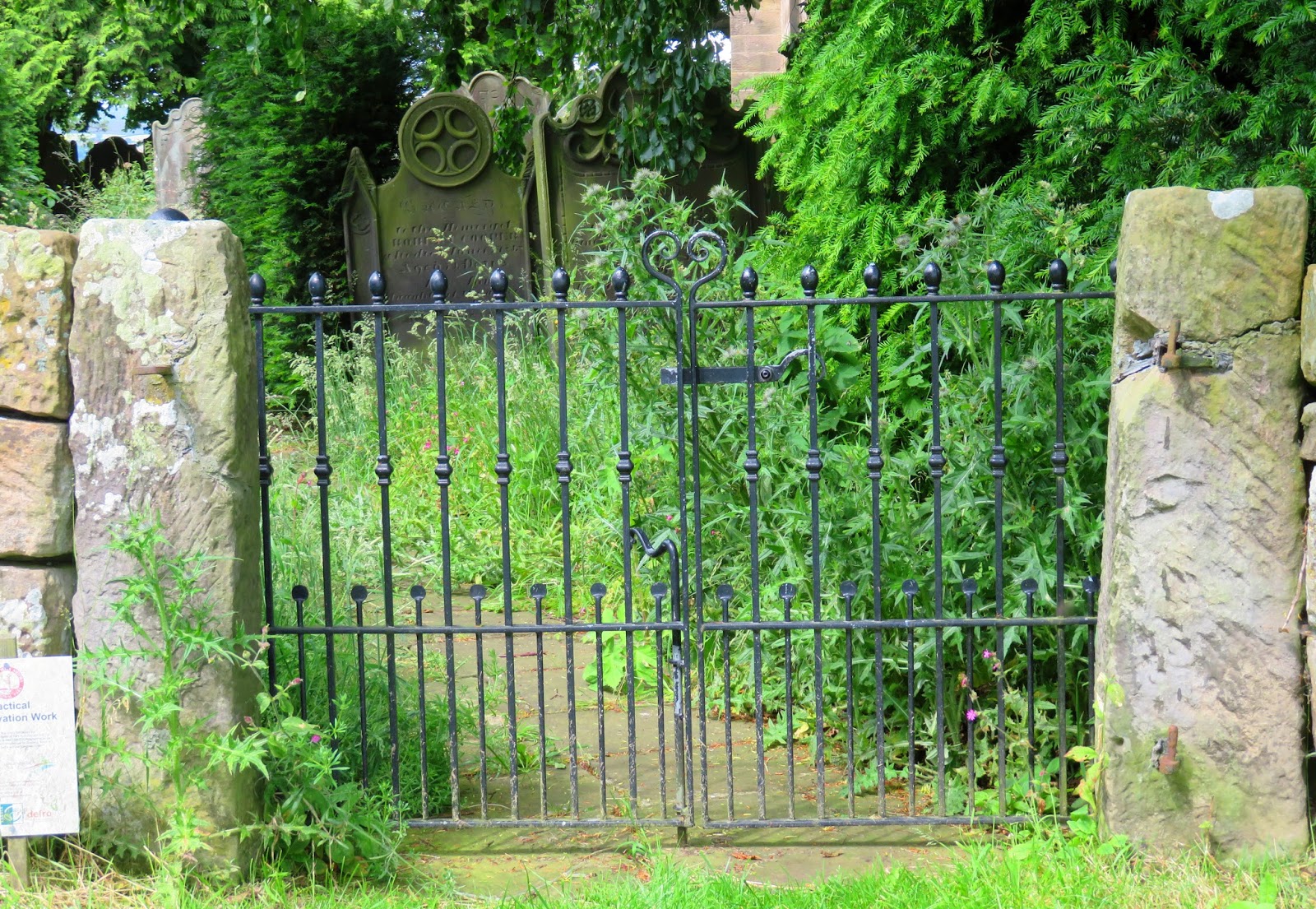
We arrived by traveling uphill on a dirt road ending up in a countryside forested area overlooking the moors and fields of cattle and sheep.  A well-worn gate greeted us just outside a stone fence that hid the chapel from view.
We fought our way through the overgrown grass in the old section of the cemetery wondering about those souls whose stones have been there for centuries. 
I am glad we were there on a sunny morning and not during a dismal rainy day.  I think I could have been easily spooked!  However, we then wandered over to the more "modern" part of the cemetery where there were graves as new as a few years ago. There were a couple of plain and worn benches where one could sit a while to enjoy the views or think of a loved one or two. 
Being very respectful, we visited the bottom part of this section and my hosts told me that some episodes of the television show "Heartbeat" had been filmed on this location.  Whenever there was a funeral or gravesite scene, this is where they filmed it.
 Upon leaving through another wrought-iron gate, I glanced back and noticed that the gate had been installed in honour of someone else who must have had a some sort of impact on Egton.
Extensive thanks to the elegant Denise Nesbitt, creator of ABC Wednesday, and to the estimable Roger, our administrator.  Also extending thanks to the exceptional team of participants who embark on visitations to each and every person and goes to the effort of commenting on other contributors' posts.

Please note that I truly enjoy visiting old cemeteries and churches but not in a ghoulish way. I love their history because where I come from, there aren't many cemeteries, and the few we do have are walled and/or gated, sometimes locked.  I think it's an honour to visit and esteem the departed who perhaps will "hear" my prayers and greet me one day at those other "gates."